
Where Does the Fed (and the Fed Funds Rate) Go From Here?

The Fed Under Chairman Powell
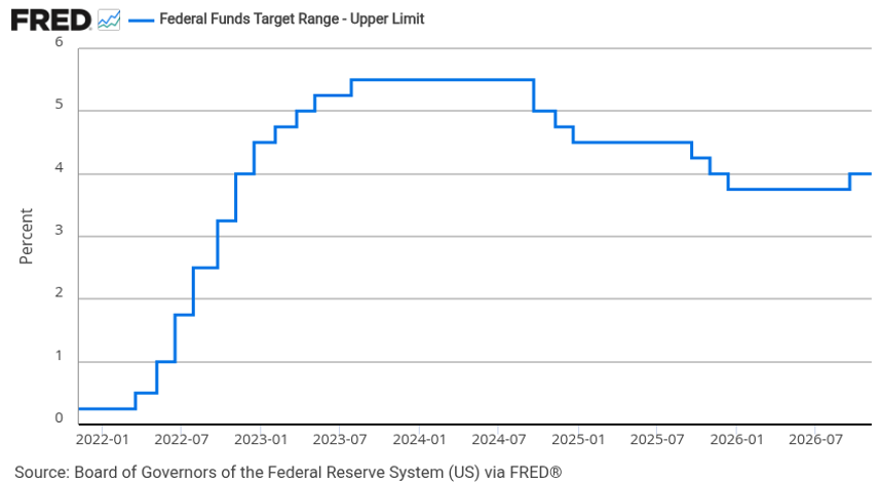
We ended 2025 with the Fed cutting the overnight rate by 25 basis points at their December meeting, which marked the Fed’s third consecutive meeting with a 25 basis point rate cut. At the time, inflation remained above their 2.0 percent target, but the Fed was primarily concerned with employment, as the unemployment rate had climbed from 4.0 percent at the beginning of the year to 4.5 percent by November. After their December rate cut, market expectations were for two additional 25 basis point rate cuts in 2026. However, this would change when the Iran War, which began at the end of February, continued to drag on and inflation started climbing again.
A New Fed Chair
When Kevin Warsh was nominated to succeed Jerome Powell as the next chair of the Federal Reserve in January 2026, many believed he was chosen by the president because he would push to lower interest rates. This thinking began to change after Chairman Warsh delivered a hawkish speech at the Fed’s Jackson Hole Symposium in late August. In his speech, he stressed the Fed’s role in fighting inflation. He said, “The Fed’s price-stability objective of two percent, as measured by the personal consumption expenditures (PCE) price index, is a firm, fixed target,” and that, "it is the Fed’s job to deliver stable prices.”
Later he touched on both sides of the Fed’s dual mandate. He discussed some concerns with employment but closed by saying, “I believe the labor markets are consistent with full employment.” He then turned to the price stability side of their mandate and stressed that, “inflation is running above our two percent target. So, the Fed's predominant focus right now should be on prices.”
This speech marked a turning point in the markets' expectations for the future direction and magnitude of rates and left no doubt that Chairman Warsh was focused on getting inflation back to the Fed’s two percent target. At the time the PCE was right at 3.0 percent year-over-year. Chairman Warsh’s comments put a rate hike in play for the next FOMC meeting on September 17, which is what we got.
Fed Funds Rate Outlook
The Fed funds future is constantly changing as economic data comes in, but it does provide an indication of where the markets think the Fed funds rate is headed. After the September rate hike, the markets were pricing in one additional 25 basis point hike before year end, likely at their December 9 meeting, and two additional rate hikes in the first half of 2027. In early November, after the release of a strong October jobs report, futures predicted a fed pause in December and a strong chance of an additional 25 basis point rate hike at their January 27 meeting. The odds for a December hike were around 77 percent and close to 100 percent for a hike by the January 2027 meeting. However, the odds for additional hikes later in the year fell below 100 percent.
Fed’s Own Outlook
The Fed releases a dot plot every other meeting which details their expectations for the Fed funds rate. When the Fed released their last dot plot at their September meeting, the median projection was for an additional 25 basis point hike in 2026. After skipping a hike at their October meeting, that would put their December meeting in play. The dot plot also showed one or two additional hikes in 2027. The Fed will publish an updated dot plot at their December meeting, which will provide a timely outlook for where they see the Fed funds rate going in 2027.
Economic Data
The Fed has told us they are focused on the price stability and inflation side of their mandate right now, and that should continue after the latest strong jobs report. We have two important inflation readings out before the Fed’s December meeting. The consumer price index (CPI) was released on November 10, with the core reading expected to climb 0.2 percent for the month. The Fed’s preferred inflation gauge, the core PCE, will be out on November 25. If these measures of inflation continue to push higher, there is a very strong chance the Fed will vote to raise rates by 25 basis points at their December meeting. One wild card is the Iran conflict. If there is a resolution to end the hostilities, the Fed could pause to see what impact that has on inflation, which has been impacted by the higher costs for oil.
Assuming the war with Iran does not end by the December Fed meeting, my bet is that they raise the overnight rate by 25 basis points with additional hikes likely in 2027.
Scott Wood is Vizo Financial’s SVP/chief investment officer. He is a NASD-registered representative, responsible for assisting the investment and liquidity needs of member credit unions.