
People vs. AI: A Risk to Job Security?

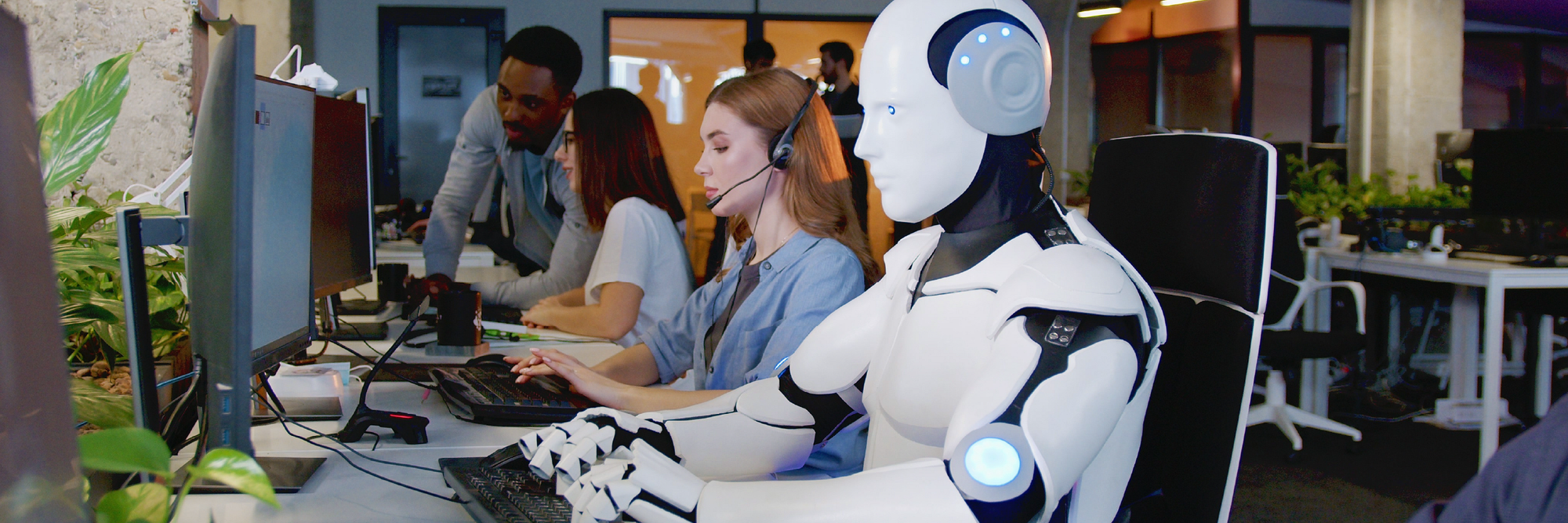
AI…it’s just two simple letters, yet few topics spark as much debate and distress across the world.
On one hand, it’s a welcome savior, one that simplifies complex concepts, summarizes data in an instant and turns time-consuming tasks into only moments of work. On the other, it’s a threat of epic proportions that shifts value from human connection to data and information.
No matter which thought camp you fall into – or even if you’re somewhere in the middle – one major concern in the Age of AI is the risk to jobs. With AI being adopted at an increasingly rapid rate, what will job security look like in five years, 10 years…or even one year from now?
But maybe that’s not the question we should be asking. Instead, it’s worth understanding the value of people versus AI and what that means for job security…because the risk may not be what you think it is.
Collaborating, Not Competing
When you clicked on this blog (thanks for that, by the way), you may have wondered, did she really write this, or did she just type a prompt into an AI engine and call it a day? That’s a perfectly fair question. That’s also the beauty of AI – it’s built for collaboration, not competition, between people and technology.
If you look at the headlines, they often talk about automation and machine learning, creating concern that job displacement and workforce reduction are on the horizon. The truth is, AI is reshaping how work is completed, moving menial responsibilities onto the part of technology while more involved job duties and strategic applications create new opportunities for workers.
Reshaping, Not Replacing
While the talk around AI and job security persists – especially for certain workforce cohorts – it’s not black and white. But this isn’t a new concept. Throughout history, technological innovation has stirred up change in the workplace and, by association, fears of what is to come. Think the Industrial Revolution, the introduction of computers and, of course, the rise of the internet – they all reshaped the way we work, from transforming manufacturing to revolutionizing office culture and communication.
According to Boston Consulting Group (BCG), AI is expected to reshape far more jobs that it replaces. Instead, the estimated trajectory of AI implementation shows that automating specific tasks can increase the value of uniquely human skills.
In the credit union world, AI is poised to analyze lending data, summarize reports, identify fraud patterns or suggest marketing campaign strategies on behalf of workers – a welcome time savings and efficiency enhancer we can all appreciate. But those tasks can’t stand on their own. Employees are still very much a necessary piece of the puzzle to interpret results and make decisions based on intelligent data, ensure ethics and clear judgment and, importantly, build member relationships.
The role of AI is to support employees, not exclude them.
Automating, Not Eliminating
In a time where information moves faster than we can keep up with, especially when it concerns technology that operates in a constant state of progress, it’s no surprise that there are misconceptions about AI’s role in the workplace.
Think of any position in your organization and you’ll realize that just that single role consists of multiple responsibilities. Tellers aren’t just greeting members and processing transactions – they’re answering questions, counting drawers, tending the drive-thru window, opening and closing accounts, ensuring compliance, sharing promotions and building rapport with everyone who walks through the door.
Many of these tasks could benefit from a level of automation, but they still require communication and critical/creative thinking. AI is not equipped to take over those pieces. Instead, it’s most effective at repetitive, time-consuming tasks, including:
- Data entry
- Appointment scheduling
- Documentation and summarizing
- Reporting
- Pattern recognition
- Simple inquiries
That’s good news for your employees, because while AI handles the routine tasks, our people helping people philosophy takes center stage, along with activities like problem solving and strategy development.
In fact, Harvard Business School researchers have found that AI brings most value not by replacing human talent, but enhancing productivity.
The Human Element
As implementation and skills of AI continue to grow, the role of people becomes even more important. Information isn’t the only piece of the puzzle that makes organizations successful. There is also a need for a distinctly human touch to set your credit union apart:
- Emotional Intelligence – For building and maintaining relationships, communicating with care, working together, understanding member needs and leading effective teams
- Critical Thinking – For oversight and evaluation of data-driven AI recommendations to make decisions that are informed and aligned with your values and goals
- Creativity – For development of original ideas and innovative solutions
AI may be able to learn quickly, organize and regurgitate results, but it is no substitute for the experience, judgment and connection that people – your employees – bring to the table.
The Skills Shift
The risk to job security isn’t AI itself – it’s misunderstanding the need for shifting skills. Employees don’t need to become AI engineers or experts in technology management. They simply need to change their expectations of how to use AI as a complement to their job. That means learning how to:
- Use AI tools responsibly and within regulatory guidelines
- Verify auto-generated data
- Write effective prompts
- Protect sensitive information
- Recognize AI limitations
- Join AI insights with professional expertise for a well-rounded outcome
In the long-term, AI literacy will be the new professional advantage, not a threat.
The Future of AI & Human Interaction
AI isn’t just a tool or technology, it’s a movement. So, it’s natural to feel uncertain in this period of incredible change. But it’s also important to keep in mind that innovation is just as much about opportunities for growth as it is for disruption of the status quo. And we achieve that by bringing together the best of both worlds.
The AI component:
- Automation
- Speed
- Data analysis
- Consistency
- Learning capabilities
The human component:
- Creativity
- Ethics
- People skills
- Strategic thinking
- Leadership
One without the other doesn’t deliver the same experience as when we bring the two together. When people can learn to leverage AI for peak productivity, inspiration and effectiveness, the organizations they serve will be better positioned for success.
For credit unions, this is particularly true because we are built on a people-first foundation and carry out a people-first mission. AI can play a role in our business operations, but human skills are something no algorithm or well-written prompt can replace.
If we invest in employee education and responsible adoption within our institutions, the risk to job security isn’t as concerning as we tend to think. Instead, let’s change our perspective and prepare for a future where people aren’t competing with AI, but working with AI.
Keeley Hartman is an information security analyst for Vizo Financial Corporate Credit Union. As such, she assists in protecting the confidentially, integrity and availability of information systems data, including both physical and data security. Ms. Hartman holds a bachelor’s degree in security and risk analysis from Penn State University Harrisburg in Harrisburg, Pa., and has achieved her CompTIA Security+ certification.