
What a Prolonged Conflict with Iran Could Mean for the Economy and Interest Rates


Have you watched the news lately? Even if you haven’t, it’s common knowledge across the globe at this point that the United States, along with Israel, are in direct conflict with Iran. In late February, multiple airstrikes and the elimination of Iranian supreme leader, Ali Khamenei, fueled the issue that is causing worldwide geopolitical tensions. Although the ramifications of this war go well beyond the economic and financial impact, we’re probably all wondering the same thing – what the effects a prolonged conflict could have on the economy and interest rates.
On Monday, March 9, President Trump said, “the war against Iran will end very soon, but not this week.” Let’s all hope he is correct for the sake of national security and the brave men and women putting their lives at risk. But even as Trump signals the campaign has largely accomplished its objectives, officials from both the U.S. and Israel are offering no timeline for an end to the conflict. So, let’s look ahead to examine some of the economic impacts if the war drags on for an extended period of time.
Impact on Energy Markets
A prolonged war with Iran would trigger a massive global economic shock, primarily felt through energy markets and supply chain disruptions. As a result, there is a very real potential for heightened inflation. Because Iran sits on the Strait of Hormuz – which 21 percent of the world’s oil and 20 percent of its liquefied natural gas pass through every year – the economic stakes are high.
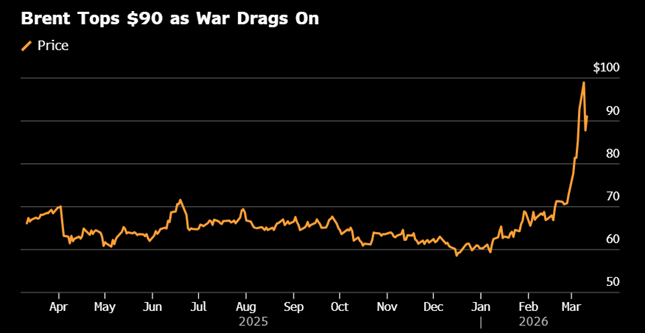
As of March 2026, the early stages of this conflict have already created significant volatility in the price of oil. Crude oil prices jumped from under $70 per barrel in early March to intraday peaks near $120, before stabilizing closer to $90 as of March 10.
Disruption to Industrial Supply Chains
In addition to the increase in oil prices, the conflict could also create supply chain and shipping disruptions, as the Persian Gulf is a vital corridor for industrial commodities. Shipping companies are being forced to bypass the region, potentially being rerouted around the continent of Africa. This adds up to two weeks in shipping time and increases freight costs. These shipping delays can eventually result in shortages, which could stall global construction and agricultural sectors.
Fiscal Burden and Market Volatility
Markets typically react to such conflicts with a “flight to quality” reaction, meaning investors will typically sell riskier assets, such as stocks, and rush into safer assets like treasury bonds and gold. Compounding this effect is the financial burden war puts on the budget. Only a few weeks in, the war has already cost the U.S. billions in munitions alone. A long-term conflict would require supplemental funding, potentially pushing national defense spending north of $1 trillion and increasing the federal deficit.
Affect on Inflation and Interest Rates
The ongoing conflict is affecting inflation in a few different ways. The most noticeable is the direct energy inflation. Gasoline prices have jumped by an average of 60 cents per gallon across the U.S. in just a few weeks. Home heating and utility costs are also projected to climb significantly in the near future. In addition to the direct impact on gasoline and energy prices, intermediate knock-on costs will also affect transportation and manufacturing. Many of these costs will likely be passed on to consumers.
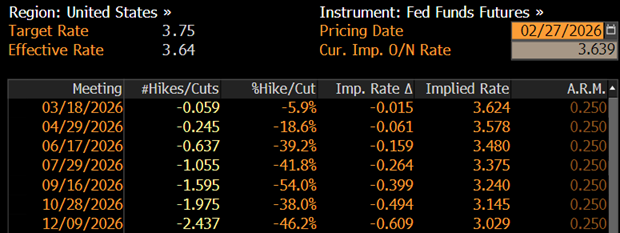
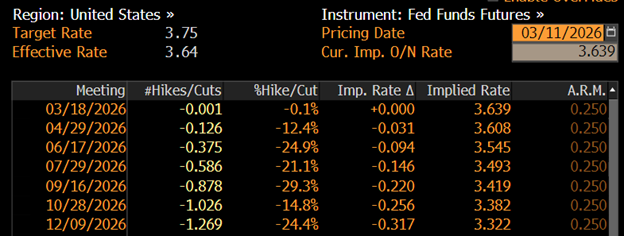
This rise in inflationary pressure is creating more of a hawkish environment for interest rates. While many economists predicted rate cuts for 2026, the war has temporarily paused those plans. Before the escalation, the expectation was that we would likely see 2.4 rate cuts of 25 basis points each by year end, as shown by the first graphic below. The conflict has now shifted expectations to just 1.2 rate cuts by year end, shown in the second chart.
How Will the Fed React?
The war has certainly created a dilemma for the Federal Reserve. On one hand, unemployment is weakening and the economy could slow down. Usually, when the economy stalls, the Fed cuts interest rates. However, due to the spike in gas/energy prices, inflation is expected to increase. Cutting interest rates in this scenario could make inflation even worse. Markets have shifted from expecting rate cuts in early 2026 to bracing for a higher-for-longer stance or even a pause as the Fed weighs the risk of a recession against that of energy-driven inflation.
Roger Heidlebaugh serves as Vizo Financial’s portfolio strategist. He acts as an investment consultant for credit unions, helping them to manage their fixed income investments, jumbo CDs and deposit accounts. On the corporate side, he analyzes, monitors and facilitates liquidity funding and investment solutions for Vizo Financial. Mr. Heidlebaugh is well-versed in the financial services industry, with over 14 years of experience as a financial advisor and expertise in managed accounts, various annuities, life insurance, investments and more.